BACK TO HOME PAGE .
Or
click here if you can't see the navigation buttons down the left hand side.

It's current controlled to make clear, stable colloidal silver that's rich in isolated ions and small particles!

Meters and Lasers

Colloidal silver water contains electrically conductive (Ag+) dissolved silver IONS, AND non-conductive, 'non-dissolved', colloidal PARTICLES. Ions and particles have completely different properties and need to be addressed separately. Here's a couple of popular optional extras that help you do just that. You can MEASURE the ppm of the ions in your silver water with a TDS or EC Meter, and you can OBSERVE the particles (colloids) with a Laser.

FOR CURRENT PRICES ON THESE PRODUCTS YOU'LL NEED TO GO TO OUR
'KITS / PRICES / ORDERS' PAGE.


(For more information about ions and particles theres a lengthy discussion at the bottom of the 'Making CS. FAQ's' page)

HM Digital 'TDS 3' PPM and Temperature Meter

A TDS (Total Dissolved Solids) meter is an extremely handy addition to your colloidal silver kit. It measures the initial purity of commercial or home distilled water, and provides a useful guide to the final ionic PPM (Parts Per Million) of your colloidal silver. Its also very handy for testing the quality of your mains water, rain water or bore water.

This good quality meter features advanced microprocessor technology.
- Hold Function (saves measurements for convenient reading and recording).
- Auto-off function (shuts off automatically after 10 minutes to conserve batteries).
- The measurement range is from 0-9990 ppm. From 0-999 ppm the resolution is in increments of 1ppm. From 1000 to 9990 ppm, the resolution is in increments of 10ppm indicated by a blinking 'x10' image.
- Temperature gauge.
- Includes a neat carrying case with belt clip.
- Uses just 2 button batteries, not 4 like the similarly priced blue Hanna TDS-1 and it has much bigger, easier to read numbers, and is easier to use than the Hanna meter too.

Note 1. All TDS meters measure the conductivity of dissolved charged Ag+ IONS only, then they convert that reading to an estimated PPM. They cannot detect or measure PARTICLES (colloids) as these are not actually dissolved and therefore they are non-conductive. In clear colloidal silver it is generally assumed that the IONIC component will constitute 85% to 95% of the TOTAL PPM. The PARTICLE component, even though it is not measurable by the TDS, would be an additional 5 to 15%. (That's assuming you started with pure water with a near zero reading). The Tyndall Effect described at the bottom of this page is the simple indicator of the presence of the colloidal particles.

Note 2. All TDS meters are factory calibrated to provide an estimated PPM for the most common dissolved ion, sodium chloride (salt) not colloidal silver. But salt is twice as conductive as silver ions, so when using a TDS meter to estimate the ionic PPM of stabilised colloidal silver, the recommended practice is to double the reading on the meter because it has taken twice as many silver ions to reach that same level of conductivity. So, for example, if the TDS meter says 6 then your actual ionic silver PPM is probably closer to 12 ppm. ALL TDS METERS work as described here! So if anyone tells you you can simply read a colloidal silver strength directly off the dial of a TDS meter, they dont know what they are talking about.

Note 3. TDS meters (and EC meters such as COM100 below) cannot distingish between silver ions and various other types of impurities, so to use them for measuring colloidal silver you must start with pure water.

You can read more about PPM and TDS meters on our 'Making CS. FAQs' page.

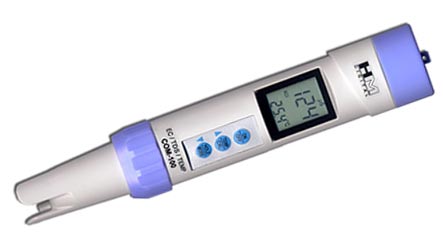
'Com 100' combined EC (Electrical Conductivity), PWT,
TDS/PPM, and Temperature Meter

Heres a great new meter at a fantastic price. It measures total dissolved solids (TDS) or PPM like the meter above, but it also measures EC (electrical conductivity) like a Hanna PWT meter. And it provides a continuous temperature display too. This unit is very simple to use 'straight out of the box' but it gives extra features to play with as you become more experienced with making colloidal silver.

Electrical conductivity is displayed in microseimens (uS) to 1 decimal point.
1 uS is considered to be equal to 1 PPM of colloidal silver so this is the easiest and most accurate method for home CS makers to determine the PPM of their 'home brew'.
(You don't have double the figure on the meter like you do with a TDS meter)

- Measurement Range is 0-9990 µS or 0-8560 ppm. (This is way beyond the Hanna PWT that only measures to 199 uS which is too low for most tap water).
- Features three different calibration options for EC mode (KCl, 442TM and NaCl) each with its own non-linear conversion factor. (EC/KCl is recommended for colloidal silver).
- TDS mode is also in 3 calibrations. (NaCl is recommended for Colloidal silver).
- Automatic Temperature Compensation using three temperature coefficients.
- Fully Waterproof (It's submersible).
- Auto-off function (Saves batteries).
- Data-hold function and low-battery indicator.
- Large and easy-to-read LCD screen includes simultaneous temperature reading.
- Platinum electrodes.
- Factory Calibrated, but the meter can be recalibrated with digital calibration using the push buttons, rather than a screwdriver.
- Includes a cap, batteries and lanyard.
- Dimensions: 18.5 x 3.4 x 3.4 cm.

High quality laser pointer

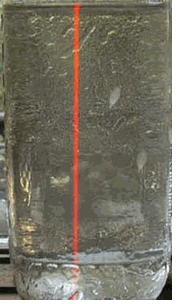
For viewing the Tyndal Effect. What's the Tyndall Effect? The easy explanation is that its light shining off microscopic particles in a liquid. It's a way to see the normally invisible colloidal (particle) portion of your clear silver water. (Particles are not detectable by a TDS meter so this is the only way to be sure they are really IN there.) See the photo below of the red laser line reflecting off the particles in the glass of clear colloidal silver.

You don't normally need this instrument to make CS, but some people like to see the results of experimenting with different processing times and other variables. This is a top quality laser pointer. All machined aluminium construction (like a Mag-Lite flashlight). Uses common AAA batteries (included), not button cells.

An example of the Tyndall Effect

The picture at left of a glass of crystal clear Silver Well CS was taken in daylight, not in the dark. The red laser line shows a dense, but not sparkly 'Tyndall effect' proving the presence of abundant very small particles.(Sparkles would indicate large particles.)

The Tyndall Effect (TE) is a visual indication of the presence of silver particles in the colloidal silver. Under a bright focused beam of light the normally invisible silver particles in the colloidal silver become visible as tiny points of light suspended in the water - even though in ordinary daylight the CS appears perfectly clear. With practice the Tyndall Effect is a visual guide to the type of CS you are making. (Whether you have numerous very small particles, mixed fine and coarse (sparkling) particles, or mainly coarse particles). For example, clear CS with a dense satin red line indicates abundant fine particles. (i.e. really nice CS, as per the Silver Well sample at left.)

Note: The Tyndall Effect is the simplest indicator of the presence of tiny silver particles but it does not reveal ions. TDS and PWT meters measure the ions but conversely they cannot detect the particles.

You can read more about the Tyndall Effect on our
'Making CS. FAQs' page.

Copyright © 2006 Silver Well Aust. All rights reserved.